Welcome to RoundDuckKira's website!
Under Construction!

So this here is my first post on this blog! The website has been long abandoned and very very very early in devlopment, but that's because I'm an unmotivated depressed tranny that has needed a long time to get her stupid life back in order. Now I feel motivated enough with a boyfriend and my own living situation and dealing with my OCD to finally tackle this desire I had for a long time.
Anyways, self deprecating slurs aside, what am I here to talk about about today? Well, my computer tastes have looped back around to ARM, and I have been using Asahi Linux lately. I have been using Linux for a Long Time™, like "before systemd was adopted by Debian" levels of long ago. 2013 to be exact, and that part hasn't changed, but back then I was using x86 hardware, being a big fan of the PC space... well kinda.
Actually, when I first used Linux, it was Raspbian Wheezy on an old first generation Raspberry Pi that looks like this:  It was slow as shit OMG, but it was a fun little computer to experiment with. I wanted the dang thing because I wanted to install Linux on my PC, but because I had a bad history where I accidently got malware installed into their computers, they locked mine down. I soon learned how to use the command line, use programs like LibreOffice, and deal with a compromised computer experience that even back then couldn't browse the web properly. I also learned that it was based on ARM, and that I couldn't run normal Linux software on it. Because of my experience using this computer, and the time I spent on RISC OS too where I got to see what ARM was originally made for, I grew a hardcore appreciation for the ARM platform. However, all good things must come to an end, and ARM couldn't run the Steam I wanted to run and the hardware was too weak to use.
Afterwards I went through period after period of using Linux either dual booted or full time on various PCs over the years. I used a Dell Latitude E6430 (that was a great lappy), a HP Omen gaming laptop that died quickly, a POS AMD E1-1200-based Gateway that barely ran Linux well, and even had my own Lenovo Legion desktop that I upgraded a little and was mine until my mom took it away due to flunking out of college. I currently have Void Linux running on a Thinkpad X220, which I should talk about soon.
However, ARM still called back to me, I wanted different hardware as a challenge, and the PC world was turning me cynical. Expensive GPUs(AND NOW ESPECIALLY RAM OMG FUCKING KILL ME), shitty cases that burned your house down, Windows becoming unusable since 10, AMD not launching Ryzen generations with non-X SKUs, mobos being expensive, and spyware god chips courtesy of AMD and Intel, yeah the PC world was depressing me. in 2020-22 in particular, there was a semiconductor shortage, making sure the only thing you could buy for a sane price being a Mac... yeah about that... (ᴗ_ ᴗ。)
So in 2020, after years of shitty Macs that burned your house down and being laptop focused and the keyboards die in months, Apple got their heads out of their asses and fixed those issues, and got to work to switching to ARM. Their chips, Apple Silicon they be called, have been on iPhones and iPad for a long time up to that point and their performance was trouncing even the lower end Macs easily, while being cheaper to produce. So why not just slap it on a Mac? They did and M1 basically destroyed the competiton. Single core performance was the best in the industry, and multicore was comparable to the territory between a 3600X and a 5600 and destroyed the laptop world easily... and it was $700 for a Mac mini or $999 for a MBA. For what you got, it was dirt cheap, even if the RAM situation could have been a lot better. So I salivated over these powerful beasts and wanted one myself, I mean it was an ARM computer that was beating desktops, not being far behind like Pis. It also didn't help that I had a missed nostalgia for Apple products when I was little, always salivating over their Mac and iPod lineups and never getting one. The one thing I worried about was Linux support, but not long after, a project was formed called Asahi Linux.
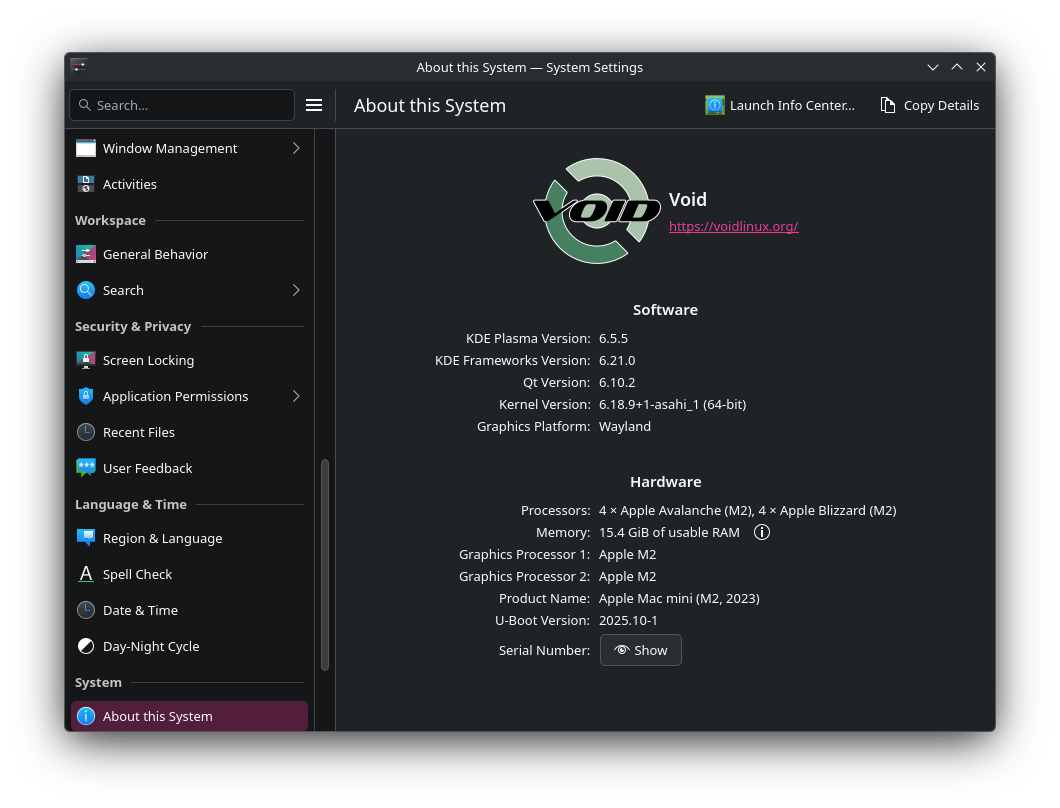
Asahi is interesting. Very interesting. The project was formed by a few ARM and ex-Fail0verflow devs that wanted to show you can run Linux on a modern Apple Silicon Mac. The project has a lot of firsts behind it. It's the first completely working Rust-based project with Linux Rust drivers, it's the first with a polished Linux DSP program, it's the first ARM-based Linux desktop that doesn't run like shit with basic integrated graphics and/or bad drivers, the first to create an easy out of the box solution to running Steam games, and it's the first mainstream computer (well the Macs themselves) to not have one of those shitty god chips in a long time. The project's suite of tools and drivers when put together instantly create one of the most polished ARM experiences on Linux.
Polished it very much is. We have Vulkan support (though kinda crap at the moment if you wantm ore than DXVK), full OpenGL 4.6 support (It can run Doom 2016! Beat that Apple!), support for the hardware bits and bobs on Apple devices, just recently got experimental USB-C display support, and the aformentioned game support by using emulation. The only big thing it's missing (besides USB-C display not being out yet) is Thunderbolt support, which sucks to not have when your Mac mini has no slot inside for internal SSD storage. Also it's M1 and M2 only, though M3 is now experimentally working!
So enough gushing aside, what is it like to use? Well the computer I have is an Mac mini M2 with 16GB RAM (oof for the wallet, but with edu pricing it was $700, like the MSRP for M1's base model) and 256GB SSD. I originally used the flagship Asahi-based distro, Fedora Asahi Remix, so I will talk about it a little when it comes to gaming and install, but currently I use (as the screenshot earlier says) Void Linux (the best distro evar!!!!) on my Mac.
Installation is very easy if you want to use Fedora or a Asahi distro that forks the Asahi installer, you just run a script into your Mac terminal, and you quickly partition and setup Asahi. However, if you're like me and used Void Linux, it's a bit harder. Basically you have to install the boot environment stuff instead of Asahi itself. Then you have to flash a USB with Void Linux and reboot into the boot environment labelled Void. U-boot then fires up and boots into the USB to start a live Void environment. BTW I recommend to do nomodeset as the Asahi drivers preinstalled into the outdated image are a bit buggy compared to the final installed environment. I set my system up personally with FDE, which made boot very slow (lack of HW accel for the algos Void uses?) but it was cool to see working when Asahi Fedora has no such option. I had to make sure too that any USB devices accessed in U-boot like my keyboard and USB drive were connected to the Type C ports, not the Type A ports as those don't work before a kernel is started. Then I set up Void, did a little customization, and here's how my system is now: 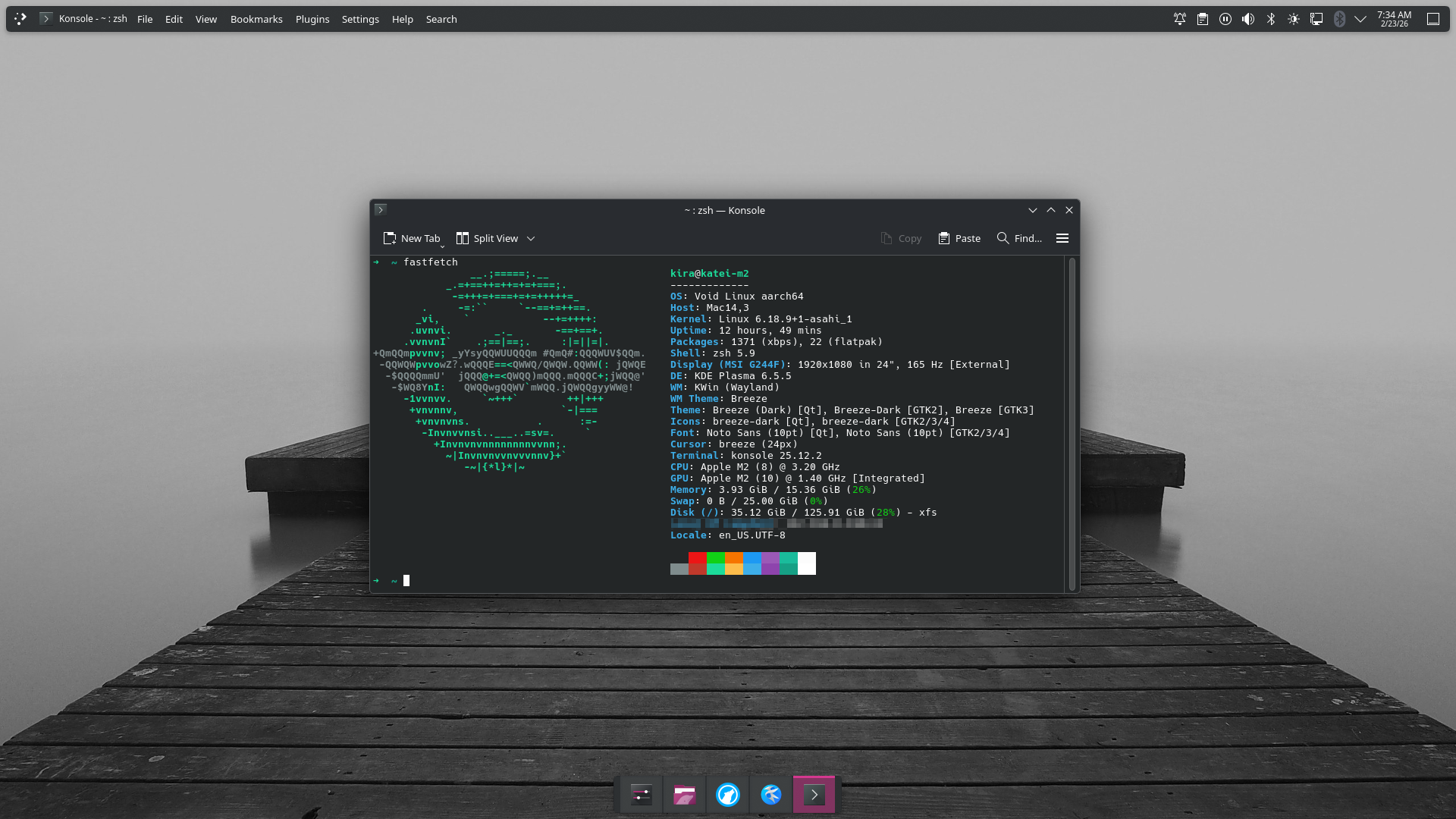
Neat isn't it? My experience overall has been pretty smooth too over the last year or so I have used it, most programs work, there's alternatives for others that are missing, flatpaks are hardware accelerated (unlike early on), my major issue is Steam. Steam has no aarch64 package on Void, and I'd love to create an asahi-steam package, but until I figure out how to compile the suite of programs Steam needs, I will have to do without. Also video encoding needs the CPU, there is no support for the media decode/encode bits of M2 or GPU-accelerated video en/decoding. You also can't remove your main HDMI plug at the moment, or video crashes. GPU drivers work great but are incomplete a bit, and thus more work needs to be done, though there is progress as I said for the support of different video ports.
Also being an ARM machine means there's cool things one can do on their machine. You can chroot into aarch64-based systems like Raspberry Pi images. You can code in ARM64 assembly! You can (theoretically) run Raspi OS binaries. You can happily run the system just fine on a cheap UPS due to its efficency. You can run VMs with ARM focused OSes!
In a nutshell, Asahi Linux is a very cool project. It's made my Mac super customizable and not locked down to Apple's walled garden! It's also just fun to try out and experiment with ARM! Being my first blog post, it's a bit rambly and unpolished, so I'll soon have to make a take 2 with updated info from using Asahi more and more, but better to start than never do anything!Overall I'm a huge fan over their project and will continue to follow them and use their work. Maybe one day I can contribute, but until that actually happens, I'll just yap about it. :p Anyways, thanks for reading!!! :D


 anything not made by me is owned by others in their own licensing, all rights reserved to them.